
Lowry's Apple Orchard
Carrying on the Old Art of Deer Deterrence

Before my wife’s grandpa, Lowry, passed away from congestive heart failure, the apple orchard became his primary farming concern. From his in-home hospice bed, he could see the orchard out his window, thirty-two trees we had planted ten years earlier. He wanted to live long enough to see a bumper crop of apples, but when it became obvious that wouldn’t happen, he wanted to talk apples. Primarily, he wanted to make sure we protected his apples from deer.
In the two years since he passed away, we have tried our best to carry out his wishes, with varying degrees of success. This past week, one of our neighbors called Natalie, during the middle of the day, to inform her that a deer was in the orchard. I was away from home, so Thomas and Natalie quickly put on rubber boots, then ran across the yard. A lone brazen doe was standing on hind legs, pilfering an apple tree. When the doe saw two bipeds charging toward her, she dropped down, bounded off, and easily jumped the temporary electric fence I had constructed.
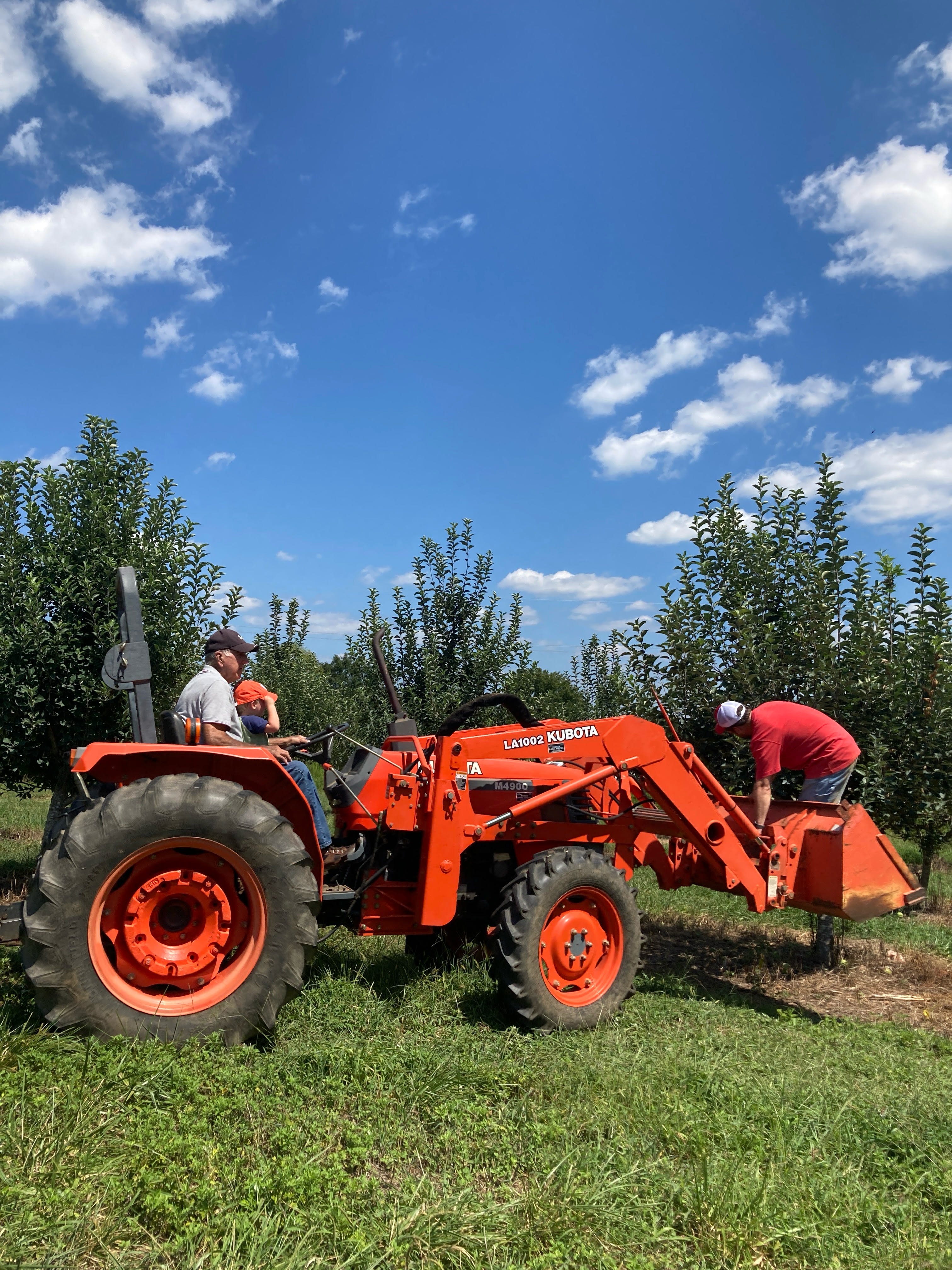
Over the years, Lowry and I experimented with several different fence designs to deter deer. Eventually, we came to the conclusion that one strand, extremely hot, was about as effective, if not more effective, than a tall multistrand fortress.
“Be careful,” Lowry said, “I’ve got the wire plugged straight into the 110 tonight.” By it, he meant a single bare wire he had running around the orchard. Sometimes, early in the season, he would bait the wire with peanut butter, so the deer would purposefully nuzzle it.
“Shouldn’t we just use the fence charger,” I said.
“Naw, this will scare them real good a time or two.” Early in the morning, he would then get up and go check the perimeter for deer prints (secretly, I think he was hoping for deer bodies).
Since Lowry passed away, I have never used the 110 trick, on account that I would probably electrocute myself in the process, but I do have the single strand fence running around the apple orchard, which is only about a quarter acre in size, hooked up to a 15-mile charger. Ideally, the deer will overlook the single strand at night, bump it, and question their life choices. It may not work well during the day, but I’d rather have a single brazen doe pilfering during the day than a whole herd plundering at night.
When I got home and Natalie told me about the deer, I went to survey the damage, fearing the worst, but if the doe did any damage, it was very little. Some of the first apples are just starting to ripen, and several of the trees are completely loaded down, depending on the variety. This year appears to be a big year for Grimes Golden, an heirloom eating apple. We’ve already picked two five gallon buckets of that variety. Unfortunately, they aren’t nearly as disease or insect resistant as some of the other varieties, but the apples taste great.
Ten years ago, we planted three main varieties: Grimes Golden, Winesap, and Arkansas Black. We bought them for Century Farms Orchard in Reidsville, NC, which specializes in heirloom apple tree seedlings. When browsing the catalog, we also noticed one variety that we couldn’t be without. It is a dark red variety that originated in 1850 in Virginia. The variety’s name is “Lowry.” We planted a single Lowry tree at the head of the orchard.
If a deer ever decides to partake of its fruit, I may have to rig up the 110.


Here’s a very modest suggestion: Deer Fishing. It would combine the relaxation of fishing with the excitement and venison potential of deer hunting. You could sell your apples as bait. They’ve been proven to work! If the deer fishermen have a few good years, you might not need to take such drastic measures to protect your orchard.