

To pay for my own personal forays into farming, I work for NC State Extension with the NC FarmLink program, a statewide program focused on farmland access and farm transition issues. In some presentations, I’ll lead by showing the following quote on a slide: “People who do not work the land have come to own it, and people who work the land have come to be increasingly unable to own it.”
This is a very Wendell Berry way of saying “Farmers can’t afford to buy farmland anymore.” The main reason I use the Wendell Berry quote is because it dates back to 1977. It’s hard to believe The Unsettling of America is now nearly fifty years old.
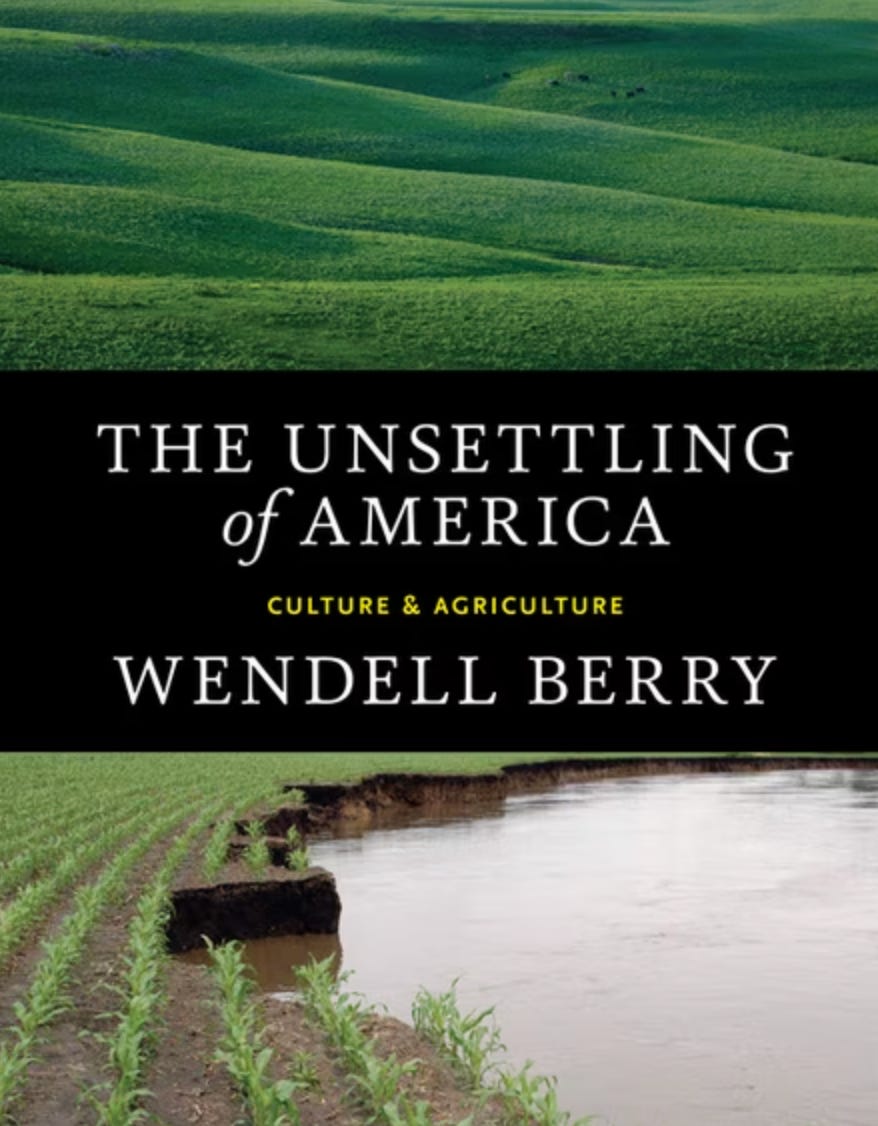
I remember when I first read The Unsettling of America. It was around 2011, and one of my wife’s coworkers had had a house fire. Lots of their books got damaged by the firefighters’ spray, and many had to be hauled off to the dump. Despite its crinkled pages, I kept The Unsettling of America from the discard pile and read it. Reading it threw more kindling, if not a giant log, onto my own burning desire to live the bucolic agrarian ideal. A few years later, Natalie and I would indebt ourself to a thirty year mortgage, buy the old family farmstead, and embark on our idealistic farming quest-- a more expensive and more difficult quest than I originally thought, hence my full-term government employment.
In hindsight, despite my many farming failures, we were lucky. We bought right after the Great Recession, when interest rates were low and it was certainly a buyer’s market. Now the problem of buying affordable farmland is many times worse than it was fifteen years ago, not to mention fifty years ago when The Unsettling of America was first published.
Rising land prices have had a cascading effects on farm transitions--1) heirs are suddenly sitting on a gold mine 2) even if a child wanted to farm, he or she probably can’t afford to buy out siblings at fair market value, and 3) new farmers outside of a family have little chance at being able to afford to buy the land if it is sold, not to mention the house and equipment needed to work the land.
As someone who works in the farm transition space, I don’t know what the answer is. I see families bicker over farmland to the point that where the families implode and the land gets sold at partition sales. I see many idealistic young farmers, like I once was, who might make good farmers but who have realistically little shot of ever being able to afford to buy a farm, unless they win the lottery.
And, in some ways, I also see the the other side of the coin, the need for a certain pragmatism that can sometimes get lost in Berry’s stringent idealism. Despite my tendency toward pragmatism at this point in my life, it’s good to know there are still some idealistic people and programs out there trying to make a difference--like the Carolina Farm Funds--which uses philanthropic gifts to buy and protect farmland, after which it sells the farmland to a young farmer at a discounted rate. Enough donors and programs like that can make a difference, and maybe that is the best we can hope for. As Wendell Berry wrote fifty years ago, “If change is to come, it will have to come from the margins.”
Below are Wendell Berry rules for rural living. I wrote them down many years ago in a notebook after reading them in a short collection of his essays. From time to time, I will review them, if for no other reason than to reacquaint myself with my former idealistic self.
Be happy with what you’ve got. Don’t always be looking for something new.
Don’t buy anything you don’t need.
Don’t buy what you ought to save. Don’t buy what you ought to make.
Unless you absolutely have to, don’t buy anything new.
If somebody tries to sell you something to save labor, look out. If you can work, then work.
If other people want to buy a lot of new stuff and fill up the country with junk, use the junk.
Some good things are cheap, even free. Use them first.
Keep watch for what nobody wants. Sort through the leavings.
You might know, or find out, what it is to need help. So help people.
Rest in peace, Wendell Berry.
Thank you for sharing! I had a similar reaction after reading the Unsettling of America last year - it cemented my commitment to the regenerative movement. I just posted a few of my own reflections on his legacy, his wisdom is incomparable