

In Shelby, we have a new park in which all the ball fields are meticulously lined and delineated for one singular sport-- soccer-- which is remarkable, considering it would have been unthinkable in a rural southern county decades ago.
I know because I grew up in Richmond County, North Carolina. We were the second poorest county in the state, but by golly that didn’t stop us from emptying out the government coffers on what mattered most. I think it was codified somewhere in the constitution of our county that two percent of our GDP had to be spent on the defensive line.
At that time, the high school football coach was the highest paid public school employee in the whole county (I’m not making this up). Of course, this was just base salary before all the kick-backs from the booster club. Our county was built around football, the American version with thousands of adults cheering on adolescent males on Friday nights. I have nothing against this version of football, and always enjoyed playing backyard football growing up, when my bones were pliable, but eventually after a dislocated elbow and broken collarbone, I was forced to take my talents to another supposedly safer sport.
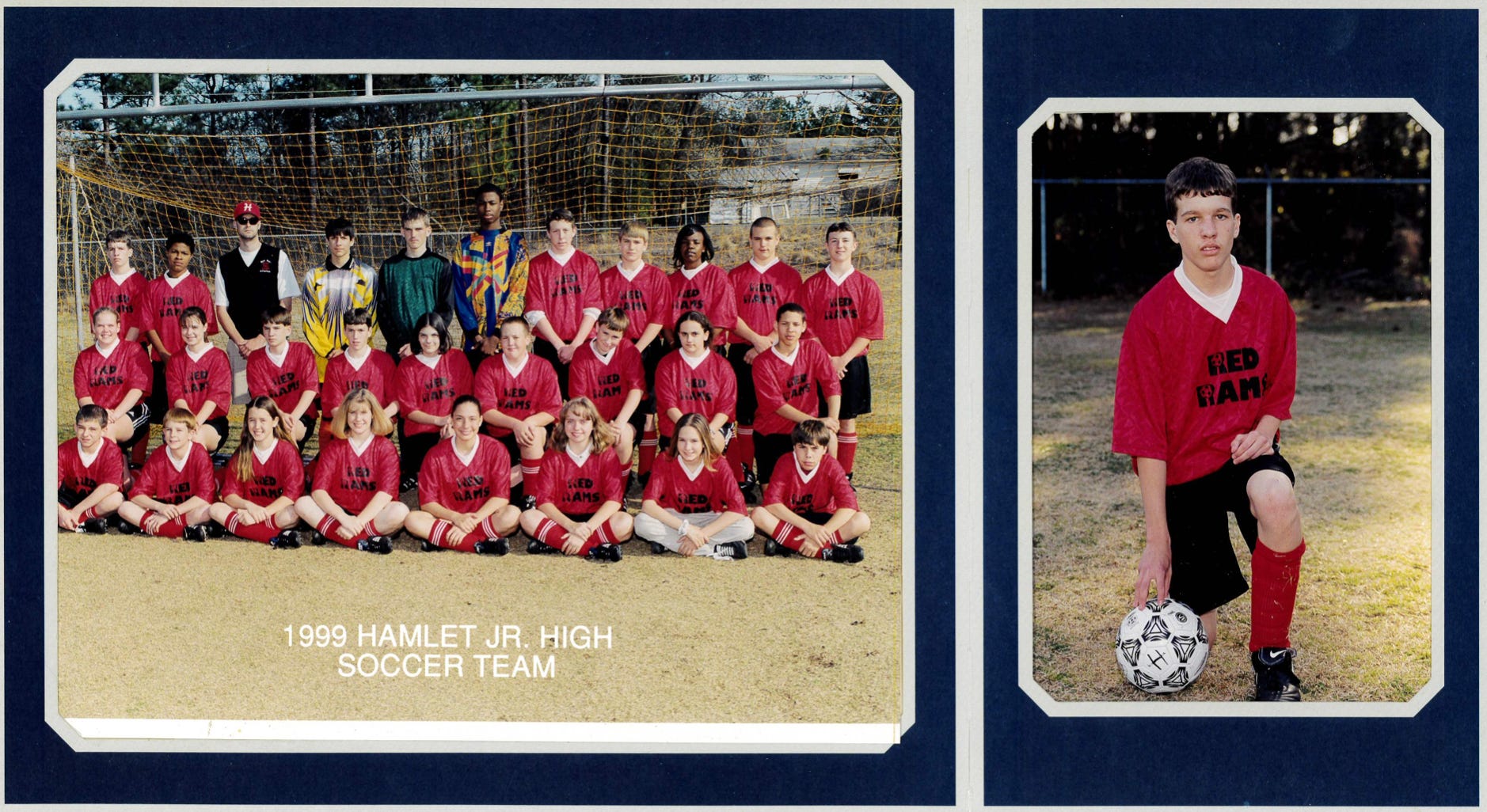
But playing soccer in the South in those days was anything but safe, as evidenced by our rural Junior High Soccer League, with its meager four teams (co-ed teams no less). Back then, it was hard to find kids who actually wanted to play soccer, so needless to say our league wasn’t overflowing with talent.
The Mill Hill Team (Rohanen) was by far the most primitive team. They resorted to face paint, bandanas, and war chants as their main defensive strategy. They had one player who had failed the seventh grade twice who never could grasp the rules of the game. He seemed to think you scored points by how many opposing players you bowled over. Beating the Mill Hill Team was never in question, but surviving them was.
The Peach Orchard Team (Ellerbe) was by far the best team in the league and made up mostly of children of hispanic farm workers. They were led by two outstanding players named Carlos and Paco, whose wizardry with the ball was wasted on most of the spectators watching our games, by which I mean humans and bovines alike. The Peach Orchard Team’s home field was a rough and tumble hayfield bordered by a cow pasture.
The main rivalry in the league was between my Small Town Team (Hamlet, population 7,000) and the Big City Team (Rockingham, population 9,000). When our two teams collided (and I mean that more literally than figuratively) it felt as if the whole world was watching, even if the only people in the stands were our blood relations, most of whom would have rather been watching the other football. “Kick the ball hard,” was the general exhortation from the parental cheering section in those days.
My soccer career peaked when I was later recruited, as a high schooler, not to play college soccer, but to referee local parks and rec games. I was given a white T-shirt that said REFEREE on the back, a whistle, and fourteen dollars in cash after the games. Apparently, in those days, finding adults in a rural county who actually knew the rules of soccer was not easy--not that you needed to know the rules to referee four-year-olds. Mostly, you just tied their shoes and pointed them in the right direction and tried to keep their parents from fist fighting in the stands.
But those were different times, back when soccer in the South was basically the Wild West. It’s good to see the game has grown in popularity, to the point where rural counties are now building parks dedicated to it, even if the game itself has taken a few steps backwards with all the theatrical flopping and corporate hydration breaks. Sigh.
But anyway, “Go U.S.A! Kick the ball hard!”